

01-28-2025, 07:54 PM
==
|
YE/D05 & 06 - Science Labs
|
|
02-06-2026, 10:08 PM
== Post-Mission ==
== Ensign T'Varen - NRC == Ensign T’Varen arrived at the Yeager’s science labs with quiet precision. The doors parted as she approached and sealed again behind her with a muted hiss. The compartment was compact and purpose-built: workstations laid out for efficiency, equipment strapped down for shipboard motion, displays streaming diagnostic ribbons and sensor summaries in steady, unemotional lines. Vulcan—unmistakably, at a glance. The restrained geometry of her features. The controlled neutrality of her expression. Ears tapering to a disciplined point—neither exaggerated nor softened for human comfort. Her dark hair was practical, pulled back and secured with nothing loose enough to catch on cabling or instrumentation. Nothing ornamental. Nothing accidental. Even stillness, in her case, had purpose. She wore the sciences division uniform as regulations intended—pressed, precise, unadorned. Yet there were tells that didn’t belong to the lab. She moved like someone who respected blind angles. Not theatrics. Not paranoia. Habit—subtle and ingrained. She paused at the threshold just long enough to register exits, lanes of movement, the placement of bodies and equipment, then committed deeper into the room without ever obstructing an active station. It was the kind of awareness that came from a primary track that hadn’t started in research. As she stepped in, a smaller deviation surfaced. Midshipman Riley Wright hadn’t appeared in the corridor, nor at any junction T’Varen had passed. The last assignment record she’d reviewed placed Wright here. Under normal circumstances, a greeting would have been… probable. She filed it away without allowing it to touch her expression. Deviation from expectation noted. Cause undetermined. Lieutenant Commander Arwen Qi was easy to identify as the senior presence. Not by volume or performance—by the way the room subtly arranged itself around his workstation. He occupied the primary console at a slight angle to the displays, posture balanced in the particular way of someone long accustomed to cramped workspaces: comfortable, not careless. Trill—unmistakably. Dark brown spots traced along the sides of his face and continued down his neck, briefly visible above the uniform collar when he shifted. And there were other markings too—ink rather than pigment—glimpses of tattooed script along his forearms when his sleeves rode back with movement. The sciences uniform was worn correctly and kept neat, but it read as working attire, not something curated for inspection. T’Varen approached without cutting through anyone’s active lane and stopped at a respectful distance. Hands folded behind her back, spine straight without stiffness, gaze steady. “Lieutenant Commander Qi,” she said, voice calm and precise. “Ensign T’Varen reporting as ordered.” She let the silence stand—acknowledgement on his terms, not hers. Then, with a smooth, minimal motion, she produced a PADD and extended it. The display had been arranged with clinical efficiency: transfer orders to the USS Yeager, current clearances, departmental acknowledgements, and a concise service history—most recently the USS Erebus, a small-crew posting where adaptability wasn’t optional. Security qualifications sat prominently among the entries, flanked by secondary certifications that made her placement in a lab less anomalous than it might first appear. T’Varen did not comment on any of it. She simply offered the documentation and waited, expression unchanged. Authority acknowledged. Parameters pending. “I am prepared to receive department orientation and begin any assigned priority,” she added. “If calibration work is pending, backlog triage is required, or there are irregularities needing initial review, I can start immediately at your direction.” She fell silent again—attentive, composed, ready to move the instant she was tasked. == Tag Qi ==
02-07-2026, 08:35 PM
The Yeager’s Science Lab was impressive, but it wasn’t home yet. Qi had been spending too much time on the Bridge to properly leave his mark. On the Geronimo, the pile of PADDs on his desk had been infamous. He knew that some of the ensigns took bets about how many there would be at the start of each shift.
The mountain, as they’d come to call it, contained a variety of distinct biomes, which changed with each passing day. A novice hiker could get lost for days in post-war Gamma Quadrant poetry, never realizing that they’d made a wrong turn at sensor diagnostics. As chaotic as it had seemed, it wasn’t clutter. A clean desk was like a sheer cliff face looming stoically above his head — the scattered thoughts around his workspace gave him a trail of landmarks to follow. Qi’s gaze swept over a report of spatial anomalies in the Wairara system. He nodded, planting a flag in that thought before returning to the task at hand. His workstation aboard the Yeager was more of a bluff than a mountain, though it still would have earned him a stern warning on most ships. Thankfully, he had some leeway in his own lab. “Lieutenant Commander Qi, Ensign T’Varen reporting as ordered.” An unfamiliar voice pulled his focus. He turned in his chair to greet it. She was Vulcan, somewhat severe. There was a certain elegance in her rigid posture. Qi didn’t detect any nerves at all. He rested his elbows on his desk, smiling warmly as she handed him a PADD. Interesting background. More varied than most, he thought, skimming the document. His lips pressed together thoughtfully as he passed the security qualifications. “Welcome aboard. Happy to have you.” Qi said, his voice soft and confident. He was in his element here. He placed the PADD between them gently, focusing on the person in front of him rather than the words on the screen. “I am prepared to receive department orientation and begin any assigned priority,” she added. “If calibration work is pending, backlog triage is required, or there are irregularities needing initial review, I can start immediately at your direction.” Qi smiled, his dark eyes glittering. He was glad to hear that his new assignee didn’t mind routine work — those tasks made their research possible — but he wouldn’t learn much about her based on how she formatted a data chip. “I’m sure we’ll have plenty of that,” he replied, “but let’s start with something a little more exciting. We just collected a ton of data from the Wairara system: astrometric, biological, linguistic — take your pick. What field draws your interest?” He shifted comfortably in his chair, studying her. == Tag T’Varen ==
02-19-2026, 05:51 AM
== Ensign T'Varen ==
T’Varen did not respond immediately. The question was framed simply, yet preference implied personal inclination, and inclination was rarely operationally relevant. She evaluated before answering. Her gaze remained steady on Lieutenant Commander Qi while her thoughts aligned in structured progression. Astrometric modeling offered defined parameters: gravimetric fluctuation curves, stellar drift projections, plasma displacement vectors. Biological analysis introduced broader tolerances. Linguistic interpretation required extrapolation from incomplete cultural context. Of the available options, astrometrics provided the cleanest foundation for hazard prediction. “Astrometrics,” she said at last, voice even and measured. “Specifically, any irregularities within the system’s gravimetric harmonics or stellar drift patterns.” Her posture remained aligned, hands folded behind her back. “If the Wairara system generated significant data volume, a mass displacement or subspace distortion event is statistically probable. Structural instability would precede secondary biological or environmental disruption. Establishing drift deviation baselines would therefore provide the most reliable predictive model.” Her eyes shifted briefly to the bluff of PADDs on his desk before returning to him. The stacks were uneven, layered without discernible indexing structure. Several leaned into one another at inefficient angles; others remained partially open, suspended between review and archival. She assessed without haste. Retrieval dependent on positional memory increases error probability over time. Proximity suggested priority. Orientation suggested recency. The system relied on cognitive mapping rather than formal classification. While adequate under immediate recall conditions, it lacked redundancy safeguards. If interrupted, displaced, or replicated by another officer, integrity would degrade rapidly. Scalability: limited. Transferability: minimal. Audit resilience: insufficient. The method functioned. That was observable. Function alone, however, represented baseline competence—not optimization. Efficiency without structure is temporary. The critique did not surface in her expression. Cultural variation did not exempt a system from analysis. It simply contextualized it. “My Security training favors environmental threat modeling,” she continued, tone unchanged. “Structural instability precedes cascading failures. I would begin by isolating sensor discrepancies requiring manual override confirmation. Automated filtering systems frequently suppress statistical outliers that later prove operationally significant.” Her gaze remained steady. “Once drift models are established, I can cross-reference biological or linguistic findings to determine correlative impact and risk projection. That sequencing reduces analytical contamination between datasets and preserves interpretive integrity.” She inclined her head slightly—acknowledgment, not concession. Silence followed, deliberate and controlled, as she awaited directive parameters. == Tag Qi ==
02-23-2026, 05:00 AM
“My Security training favors environmental threat modeling. Structural instability precedes cascading failures.”
Qi followed the Vulcan’s gaze to his collection of PADDs. He nudged Romulan cryptography into a sturdier position underneath Navajo code talkers, preventing a small cascading failure of his own. He guessed that his system horrified her though, to her credit, she didn’t show it on her face. “I would begin by isolating sensor discrepancies requiring manual override confirmation,” T’Varen continued. “Automated filtering systems frequently suppress statistical outliers that later prove operationally significant.” His hand went automatically to the flag he’d just planted in spatial anomalies, then followed the trail down to sensor diagnostics. He handed the stack to T’Varen, along with a history of local star charts, for good measure. “See how far you get with this. I’ll check in on your progress at the start of tomorrow’s shift,” Qi instructed. “Though I’ll caution you against reading too deeply into sensor discrepancies. Keep in mind that the ship is literally mashed together from spare parts. It works somehow, but it’s a miracle that both sides go to warp at the same time.” He let the thought breathe for a moment, confident that he’d made his point. Any officer serving on the Yeager would need to be comfortable with some amount of mess. “Can I ask, by the way,” He said, putting both elbows on the desk between them, “why the department change? Not just for my own curiosity, but so that I know what kind of work you’re interested in.” == Tag! ==
04-13-2026, 06:44 AM
== Mission timeline ==
<<<< Science Lab <<<< Qi sighed as he shut the drawer to his desk. He’d done his best to tidy up, but he knew that the lab still wouldn’t pass a formal inspection. Starfleet regulations prioritized uniformity and order, with little care for how science was actually performed in the field. Sometimes a little chaos is necessary, he mused. That gave him an idea. “Computer, display a map of the area around Starbase 214. Highlight any nearby bodies that are larger than a class 3 probe.” Qi prompted, resting a palm on the tabletop holographic display. He had a plan to run by Jadaris when he arrived. == GM Input: Are there any known bodies (asteroids/moons/space junk) that would be large enough to hide a probe behind? ==
04-15-2026, 11:25 PM
There were several bodies behind which a probe might be concealed. The diminutive size of a probe (roughly two meters long by half a meter wide and half a meter deep) meant that it took up an infinitesimal amount of space, when considered on a galactic scale.
The issue would be where to hide it where it could actually get a good look and be able to broadcast its finding without being detected. For that, there were a few options, but would require some extra fine-tuning of the probe's guidance systems to be effective. The easiest option would be to set the probe's sensors to passive only, launch it through the system on a ballistic trajectory, and recover it at the other end.
04-22-2026, 06:58 AM
Jadaris entered the science lab, making a detour to the geophysics lab to run a calculation, before heading over to where Qi was generating his simulation.
"Any luck Qi?" Jadaris walked over to the simulation, looking at what Qi was doing. "Were you running an asteroid composition simulation so we can baffle any active sensors with a sensor cloak, or something else?" ==tag Qi==
04-27-2026, 10:25 PM
A steady baritone voice came over the comm.
[Midshipman Qab'ataar to Lieutenant Commander Qi. I'm on board, where would you like me to meet you, sir?] == Tag Qi ==
04-29-2026, 02:45 AM
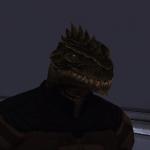
Qi greeted Jadaris warmly. The towering Gorn seemed well-suited to the ship’s cavernous engineering bay. The lab, by comparison, seemed a bit like a child’s playhouse as he hunched through the doorway.
“I was hoping to find an asteroid that we can hitch a probe onto. That way, we can take advantage of any blind spots on the Cardassian side while collecting information about what’s happening on the other side of the blockade,” Qi explained, moving a seat to the side to make room for his colleague. “I think our best option is just to hurtle something through the system in passive mode and hope that they don’t notice. Unless you have a way to collect more data?” [Midshipman Qab'ataar to Lieutenant Commander Qi. I'm on board, where would you like me to meet you, sir?] Qi’s mouth opened. Was this really the best training mission for a new midshipman? Most cadets don’t dream of skirting up to the line of war. Might as well get it out of the way now. Welcome to the Yeager, he thought with a sigh. He tapped his combadge. “Welcome, Qab’ataar. Cdr Jadaris and I are running some simulations in the lab. Join us here once you’ve stowed your luggage.” == Tag Jadaris/Qab’ataar ==
04-29-2026, 12:13 PM
[Understood, sir.]
04-29-2026, 10:52 PM
<< Crew Quarters <<
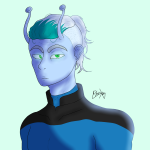
Ris entered at a calm pace as the doors opened in a susurrus of air. His eyes went a bit wide at seeing the large form of Commander Jidaris. A Gorn!? In Starfleet!? I must have missed that memo! Usually rumors of that nature even reach the Academy. This is quite the surprise. His antennae reacted on their own, going into "alert" mode, panning back and forth swiftly, and he was simply unprepared for such a surprise that his breath caught. "Mid-Midshipman Qab'ataar reporting as directed, sir. Gear is stowed in my quarters."
05-03-2026, 07:36 PM
Qi pulled his focus away from the computer terminal. For a moment, his eyes were blank, still lost in the problem at hand. He blinked away the maps and diagrams, eventually seeing the tall Andorian standing in the doorway. There was a look of hesitation or nervousness on the young crewman’s face. Qi couldn’t tell whether it was typical nerves, or an instinctive reaction to the sight of a hulking Gorn. Either way, Qi’s job was to put him at ease.
“Welcome aboard. You can call me Qi. This is our Chief Engineer, Jadaris,” Qi replied. He preferred not to use ranks in the lab. Hopefully, this new academy graduate would adapt quickly. “We’ve been trying to hash out a bit of a problem,” Qi began, considering how much he wanted to reveal. This was a sensitive matter, but good science was about seeing the full picture. Candor won out. “The Cardassians are blockading a starbase. The details of why aren’t important. What is important is that we want to get a good look at their ships — and what’s happening on the starbase — without drawing too much attention to ourselves. Any thoughts?” He let the holographic image of the starbase hang in the air, giving Qab’ataar a moment to think. == Tag Jadaris/Ris ==
05-03-2026, 08:41 PM
“Welcome aboard. You can call me Qi. This is our Chief Engineer, Jadaris,”
The soft voice helped serve as an anchor for Ris' focus, and drew his attention to his Department Head. “We’ve been trying to hash out a bit of a problem," he continued. "The Cardassians are blockading a starbase. The details of why aren’t important. What is important is that we want to get a good look at their ships — and what’s happening on the starbase — without drawing too much attention to ourselves. Any thoughts?” Okay, that's a good problem to focus on. He narrowed his eyes a bit and pondered the holographic image floating in the air. "Well, sir, do our probes have the capability to mask or change their IFF signal? Make it look like a friendly, or at least a neutral? Barring that, what about making one probe really loud, figuratively speaking, to draw their attention in one direction and send in a couple others much quieter from the opposite direction." Ris hesitated a moment. "Something I've learned is that sometimes the 'why' is the most important data point, as that informs their motivations and/or their goals, sir." While not addressing him directly, Ris' eyes moved to glance to Jidaris, albeit briefly when he made his last point. ** Tag Qi/Jidaris ==
05-04-2026, 08:50 AM
“I think our best option is just to hurtle something through the system in passive mode and hope that they don’t notice. Unless you have a way to collect more data?”
Jadaris sat down in thought, manipulating probe locations, and then Qi's new midshipman reported in. By the time the midshipman was in the science labs, Jadaris was still running computations. "Well, sir, do our probes have the capability to mask or change their IFF signal? Make it look like a friendly, or at least a neutral? Barring that, what about making one probe really loud, figuratively speaking, to draw their attention in one direction and send in a couple others much quieter from the opposite direction." Jadaris looked over at Ris and said, "A good insight. The Cardassians will be suspicious if they detect a spoofed IFF probe however, since they keep track of what's transmitting and where. They'll probably send a ship to investigate the probe's signal if its detected, so stealth probes are our best option in that case. I believe I can get a sensor cloak working however, since we do have a smaller sensor signature, and I can make the necessary modifications to baffle any sensors. Masking our energy signature, running in passive mode, but then there's getting any probes we have into the system. If we use a class eight probe as a....what do the humans call it....piggy back carrier, then we could load several class threes onto a single eight, have it warp in to the edge of the system, detach the threes and have them relay any sensor data to the eight, and then bounce that probe's data stream to us, either by a tight channel, or by different means such as a compressed data pulse." He looked at the Andorian that had spoken up and added, "Commander Jadaris, Doctor of geophysics from the Vulcan Science Academy, QSD specialist and Chief Engineer. I don't bite or spit, and I'm in charge of keeping this ship from falling apart at the seams. I'm just worried about the Cardassians having a trick up their sleeve to interrupt our Quantum Slipstream Drive that'll let us get into the system. A sufficiently large graviton pulse could knock us out of QSD with severe damage, which was what happened to the Callisto when we were assigned as part of the Pathfinder expedition to the Delta Quadrant in pursuit of the Borg." ==tag==
05-04-2026, 12:08 PM
The imposing Gorn faced Ris and directed a verbal response to his own non-verbal response moments ago.
"Commander Jadaris, Doctor of geophysics from the Vulcan Science Academy, QSD specialist and Chief Engineer. I don't bite or spit, and I'm in charge of keeping this ship from falling apart at the seams. I'm just worried about the Cardassians having a trick up their sleeve to interrupt our Quantum Slipstream Drive that'll let us get into the system. A sufficiently large graviton pulse could knock us out of QSD with severe damage, which was what happened to the Callisto when we were assigned as part of the Pathfinder expedition to the Delta Quadrant in pursuit of the Borg." Ris felt the chagrin creep up his neck, seep across his face, turning his normally powder blue complexion a darker shade of blue, and continued on to the tips of his antennae. As part of his physical reaction, the tips of the antennae curled slightly inwards, like fingertips. "Four years at the Academy with all of its diversity still didn't prepare me for this. I am sure it's a common reaction, Commander, but I offer my heartfelt apology." A momentary beat of silence briefly appeared. "Regarding the probe situation, the use of a larger probe to act as a mothership for the smaller ones seems a good place to start. My focus in the Academy was EM radiation, so perhaps I can assist with tuning the smaller probes' sensors and output." He paused a moment in thought. "My only knowledge of the Cardassians is what's taught at the Academy, and interpecies relations wasn't my focus. Given what you know of them, would making the Class 8 probe a little more obvious help or hinder our information gathering efforts?" As he started "tucking into" the situation at hand, Ris' body language showed a return to a calm, relaxed state. == Tag Jidaris/Qi ==
05-04-2026, 12:09 PM
== Apologies for misspelling your name in the tag, Jadaris. Missed it both times I previewed the post, too. ==
05-12-2026, 06:29 AM
“Using the class 8 probe as a red herring is pretty sneaky. I like it a lot,” Qi said, nodding toward the new crewman. “Then we should be able to establish a sensor net with the scattered Class 3 probes while they’re operating in stealth mode.”
Qi entered a string of commands into the simulation, watching as a dot representing each probe appeared on the holographic display. “I doubt that the Cardassians will hesitate to destroy the big probe once they detect a warp signature, but they’ll have their guard up from that point forward if we think we’re trying to get one over on them. That might hinder our ability to keep a low profile.” Qi untied and retied his hair, twisting the cloud of curls behind his head. Paranoia was ingrained into every level of Cardassian culture. Trying to pull the wool over their eyes was a fool’s errand, but they may be able to create enough confusion to buy themselves some time. “I think we would be better off piggybacking the class 3 probes onto something that will catch their attention without telegraphing our intentions. I think we should try to make the Class 8 look like something that’s been floating in space for a long time, rather than something that we launched today. We can spoof some of the data and bang it up a bit to help sell the idea that it’s been running autonomously for years.” Qi shrugged. He’d always been a good liar, though he hadn’t quite expected that skill to come in handy. == Tag Ris/Jadaris == GM Input: Are there technical issues with using the class 8 probe to distribute the class 3 units into strategic locations? ==
05-13-2026, 11:09 PM
“I think we would be better off piggybacking the class 3 probes onto something that will catch their attention without telegraphing our intentions. I think we should try to make the Class 8 look like something that’s been floating in space for a long time, rather than something that we launched today. We can spoof some of the data and bang it up a bit to help sell the idea that it’s been running autonomously for years.”
Ris nodded slightly as his brain chewed on the problem. Maybe I should have paid better attention in the classes on interspecies relations, especially those powers that are antagonistic towards the Federation. Peering over the holographic display, his antenna bobbed back and forth very slightly - more of a sway, really - Ris narrowed his gaze slightly. As the seed of an idea germinated within, he slowly stalked around the projection to gain differing vantage points. "Commander, sorry, Qi, can you run this through a backwards and forwards loop so we can see how the various celestials will be positioned around the time frame we want to deploy these probes?" His brow furrowed slightly as his focus increased, and his antenna locked forwards. "Bringing in the Class 8 behind a moon, or something similar, might be just the edge to get the Class 3s into position without the Cardassians noticing. That will also help us figure out just how much EM spoofing we'll need to do." == Tag Qi/Jadaris == == GM Input: within the time frame of probe earliest Class 8 probe arrival into the system plus seven Earth standard days, which of those seven days would put the celestials (planets, moons, asteroids) in between where the station is and where we want out probe package to arrive? ==
05-14-2026, 07:21 PM
"Four years at the Academy with all of its diversity still didn't prepare me for this. I am sure it's a common reaction, Commander, but I offer my heartfelt apology."
Jadaris nodded back, "No apology necessary. Its hard for a lot of people to get past the fact that my species is known for their past atrocities against Federation citizens. If you'd like, we can discuss the reasons why a Gorn is in Star Fleet over a cup of hot tea in the mess hall when our respective off-duty shifts align." “I think we would be better off piggybacking the class 3 probes onto something that will catch their attention without telegraphing our intentions. I think we should try to make the Class 8 look like something that’s been floating in space for a long time, rather than something that we launched today. We can spoof some of the data and bang it up a bit to help sell the idea that it’s been running autonomously for years.” Jadaris turned back to the projection. "The problem is the class threes are short range probes, meaning we'd have to get the class 8 in close to the Cardassians. However, a three stage booster isn't out of the question. A class 8 to boost them into the system with the wear and tear of a long range probe launched by the starbase, that we program its home base and point of launch to be the starbase, and we attach a class 5, which is a probe designed to collect planetary samples and has a higher sublight thrust rating to avoid subspace sensors, but is loaded with partial planetary samples we can replicate as being from one of the planets in the system, and then a pair of ancillary class threes that act as the scanners we need, and can get into position. We'd have to use the warp engine on the class 5 to generate an alteration in the warp harmonics so that we can expand the warp bubble around the two class threes, but its possible to do. And making the probes 'dirty' would lend credibility to them having been launched as part of a long term mission in case they're discovered. We could also load smaller planetary samples into the class threes in case they're discovered and captured by the Cardassians." He pulled up a class 8 design on the holographic viewer and made some exterior modifications. "If we use breakaway mounts on the class 8, we can replicate asteroid collision damage, which would give the probe some credibility that it was on its way back and suffered asteroid damage that prevented it from attaining high warp speeds to return home with." "But this still doesn't solve the issue of disguising ourselves, and I'm still wary of the Captain's order of us using the Quantum Slipstream Drive to get there, because I have a sneaky feeling that the Cardassians want us to use the drive, to test some countermeasures of their own against it. Gravity waves are one of the few ways to disrupt a QSD tunnel, and the last time that happened, we almost lost the drive." ==tag==
05-14-2026, 11:45 PM
==Qi==
Though it was possible to piggyback three Class Three probes on a Class Eight, it would have several adverse effects - the Class Eight would be effectively blind until the other probes had been disengaged, it would be unable to maneuver beyond its initial programmed course, and the energy drain would significantly reduce range and operational duration. The latter two issues could be overcome by launching the probes in a dormant state, only coming online after a predetermined amount of time, but that would carry its own risks. ==Qab'ataar== Depending on how close the probes wanted to get, and whether or not the probe needed to land on a surface or coast through space, there was no specific day that would be any better than the other. The closer the probe got to the base, however, the easier it would be to detect and the more it would have to navigate around other objects in the system - something that would be far more difficult if the conglomeration of probes being recommended was deployed.
05-22-2026, 01:00 PM
Ris allowed himself a slight sigh.
Well, that doesn't help much with plotting a planned insertion point. He pointed out the pros and cons of each point during the projected orbital movements. "Based on what we're seeing here, the best case would be an earlier insertion, with a relatively brief initial acceleration, and then using small thruster bursts to adjust course and heading." He frowned slightly, and his antennae curled down towards his scalp a few millimeters. "I'm not as well-versed on the engineering side of things as you are, Commander Jadaris. Am I understanding it correctly that the simulation doesn't like the probe configuration we're proposing?" == Tag Jadaris / Qi ==
05-23-2026, 05:11 PM
[Security to Science Department:
Please report current status at earliest convenience. We advise preparedness for combat readiness.]
05-26-2026, 06:52 AM
Qi bit his lip. Every possible solution carried its own set of risks — and not only to the ship. A catastrophic mistake could mean war. He felt a chill run down his spine. They needed to think harder. The Cardassians likely expected some sort of trickery. The key would be to make sure that they didn’t feel threatened.
“I think I like hitching the class 3 probes onto the class 8 in a dormant state. We’ll have to be precise about when the smaller probes bail out, but the Class 8 will look innocuous enough when the Cardassians detect it.” He flipped the holographic image to a detailed schematic of the ship’s power system, taking a moment to let Qab’ataar study it. “This is our next problem: the ship draws a lot of attention. Many of Yeager’s systems are overpowered, and our sensor fingerprint is fairly distinctive. While I would love to start work on a cloak,” he sighed pointedly, “it’s out of the question for now. In the meantime, I think we need to seriously downplay our firepower. Assuming that the Cardassians discover us at some point, it sends a much different message if we look like a scout vessel, rather than a warship. Any thoughts on how to do that?” The holographic image floated in the air. Glowing lines coursed over the ship’s skeleton, tracing each system’s power intake. Just then, d’Tor’an’s voice sounded over the comm system. Qi replied, giving Ris some more time to come up with a proposal. “Science here. We’re working on a plan to minimize our sensor profile,” Qi replied. “Let us know if the Treaty of Algeron dissolves while we’re en route. That would make our job a lot easier.” == Tag Jadaris/Ris ==
06-07-2026, 07:03 AM
"I'm not as well-versed on the engineering side of things as you are, Commander Jadaris. Am I understanding it correctly that the simulation doesn't like the probe configuration we're proposing?"
Jadaris nodded, "The problem is that the warp-capable probes are incapable of generating their own warp field, only sustaining an existing field. And if we're entering by slipstream, we can't launch a probe while in slipstream. So, we could just refit the class three probes with expanded fuel reserves but take out the sample collection equipment, that way the probes will have extended ranges at extremely high sublight velocities that won't be detectable." He turned back to Qi and said, "That trick might work if we weren't infamous. However, if we take the idea of a Q ship, we can place barriers over our weaponry that we can blow at a moment's notice, ones that act as sensor baffles tied into a proto sensor cloak. There's also the possibility we could use the proton buildup on our sensor arrays to alter our reflective profile, to either scatter our signal and look like sensor noise, or reflect back a smaller profile. Gravimetric sensors would be able to sniff that out easily though, as could subspace sensors, limiting what we can do without a visual cloak. The Cardassians do possess cloaking technology though." ==tag Ris and Qi==
06-07-2026, 10:04 PM
Listening to the rumbling voice of the Gorn Chief Engineer's response to both his and the Chief Science Officer's queries, Ris'maeriiffa focused in on the the meat of what was being said. As he did so, his antennae tips extended slightly forward, as if they were reaching for something.
"Who on this ship knows the Cardassians really well? The way they think, their overall cultural outlook, filters, and biases? Especially where it concerns the Federation? Maybe there's something in there we can play into to slide into a blindspot." He paused. "Much like your brain can fail to register a creature or other object that's so out of place that it convinces itself it's not real." He allowed himself a slight shrug of the shoulders. "At the risk of impertinence, I will point out again that they 'why' of their actions is arguably important in determining how we counter them. I'm also well aware we don't have a lot of time to decide on a course of action, and analysis paralysis is a well-known and studied condition. I just prefer to have a bit more information in the decision tree." A beat. "Sirs." == Tag Qi and Jadaris ==
06-16-2026, 12:14 PM
Ris'maeriiffa had done his best to work with both Commander Jadaris and Lieutenant Commander Qi in the preparation of the probe they intended to use. For his own part, he offered his own knowledge and expertise on the EM radiation side of things, and offered feedback when the two senior officers requested.
Having a goal to work towards felt good, though he had to remind himself more than once of the axiom, "Perfection is the enemy of progress." At some point the Captain had announced their arrival in system, and the real challenge began. He tapped his commbadge, and after it gave its signature chirrup, he spoke. "Acknowledged. Midshipman Qab'ataar en route to bridge." >> Bridge >>
06-22-2026, 04:01 AM
Qi smiled, more than happy to delegate Bridge duty to the new midshipman. Surprisingly, it seemed that the young Andorian seemed to jump at the opportunity. Qi could still remember sweating through his uniform as he stepped up to the science console aboard the Yoritomo, years ago. Though he no longer dreaded the time spent in the hot seat, his proper place had always been here in the Lab.
Before long, the time for deliberation ran out. The ship had arrived at the edge of Federation space, just out of the starbase’s view. Showtime. Thankfully, the sensor modifications that Jadaris proposed were relatively straightforward. Though Qi was no engineer, it seemed to him that gutting the sample collection equipment to make room for additional fuel would actually reduce the complexity of the probe mechanism. He recalled an old Earth saying he'd once heard: Simplicity is the ultimate sophistication “The ship is running in Condition Grey, which should minimize our own sensor profile,” Qi said, studying a heat map of the Yeager’s energy distribution, “Let’s go ahead and launch the probe with your proposed modifications. We want to launch before the Cardassians are thinking to look for it.” Qi prepared a link of the probe’s telemetry so that it could be accessed directly from the Bridge console. With any luck, Qab’ataar would have a chance to impress the captain soon. “What do you make of our new scientist?” Qi asked, making idle conversation as he worked. “Certainly seems like he’s up for a challenge. I just hope he doesn’t crack under pressure. Things can get pretty intense up on the Bridge.” == Tag Jadaris GM Input: Are we able to get the modified probe into range of the starbase without being detected? ==
06-22-2026, 06:59 PM
==Post Timeskip==
“Let’s go ahead and launch the probe with your proposed modifications. We want to launch before the Cardassians are thinking to look for it.” Jadaris nodded, "We should have launched just after we left the quantum slipstream. I could have interfaced the probe's deflector geometries with the slipstream corridor and allowed it to stay in the slipstream for a few microseconds to get it into the system, but we'll have other chances to try that out. We should launch it using inertial forces only, so we don't have any engine flares until it gets far enough away from us. That being said, subspace sensors are more likely to pick us up than a probe." Jadaris set about handling the launch when the lighting began to dim, and he entered in the necessary commands to his PADD to enforce Condition Grey by dropping warp output to minimal levels. He also put in place similar instructions for the bridge to be able to use a sensor cloak if they needed it, forwarding on the necessary instructions to the Science console on the bridge. "Certainly seems like he’s up for a challenge. I just hope he doesn’t crack under pressure. Things can get pretty intense up on the Bridge.” Jadaris shrugged and replied, "My first day on the bridge as a newly minted Science midshipman, I located an underwater base with magnetotelluric sensor techniques and used Zaldan diplomacy to insult an alien race. I've got pretty high standards for screwing up as badly as I did, so I trust that he'll either blow us all up so we won't notice how badly he screwed up, or he'll successfully make the Cardassians look like fools so much that he joins Captain Braggins on their tried-in-absentia list." Jadaris continued to set up the ship's active sensors as a means of maintaining the sensor net through active obfuscation, so if the sensor cloak was activated, the active sensors would produce cosmic background interference and cause active sensor probes to appear as if there was asteroid interference. "Can you check the sensor interference calculations to ensure that we're emitting background radiation at a level that wouldn't be considered abnormal to a Cardassian scan?" ==tag== ==GM Input: Is Jadaris successful at setting up an improvised sensor cloak for the bridge to use?==
06-25-2026, 06:34 AM
Qi nodded, swiping through a series of holographic displays until he arrived at the one he wanted. Typically, the ship’s external sensors were designed to monitor its surroundings, but they could just as easily be used to look at the ship itself. In fact, the sensors were usually programmed to ignore the Yeager itself, which was always the biggest, brightest thing within their field of view. In this particular case, it was actually useful to see the ship as it would appear from the outside.
“A diplomatic incident on day one? That’s rough, but I think I have you beat,” Qi replied, considering Jadaris' story. “The first time I set foot on the Bridge as an ensign was the day the Yoritomo was destroyed. I tried to disable a Romulan orbital defense weapon with a photonic burst. It, um, only partially worked.” Qi rubbed his neck, a strange mix of dreamy nostalgia and embarrassment washing over his face. He'd been so consumed by fear and insecurity during the early days of his career. Was this how it would feel to look back on a past life? He opened a private link to Ris. He hated to be a mother hen, but swapping disaster stories with Jadaris seemed to trigger a protective instinct. “Qi to Qab’ataar, we’re launching the probe now. I'm sending a live feed of telemetry to your console. By the way, can you kindly remind Crewman Chertstone at the helm that this mission is not a race? I’m not convinced that ‘slow and steady’ is in his vocabulary.” == Tag Jadaris ==
06-28-2026, 01:22 AM
“Qi to Qab’ataar, we’re launching the probe now. I'm sending a live feed of telemetry to your console. By the way, can you kindly remind Crewman Chertstone at the helm that this mission is not a race? I’m not convinced that ‘slow and steady’ is in his vocabulary.”
[If needed, I will tactfully remind the Chief of that LimFac, sir,] came the measured response.
06-29-2026, 09:26 PM
[Security to Science: Request for information regarding recently-launched probe.]
[Message automatically CC’d to Captain Braggins]
07-04-2026, 03:58 AM
Qi winced — first, at having forgotten Chertstone’s recent promotion. Then, at the coldly professional reply that he received from Qab’ataar. He hadn’t been serious about his comment toward Chertstone. Even if he had been, the pilot’s head was too big for his own good. He needed to learn some humility. Just because he won the Wairara’s race didn’t mean that he could strut around the ship like he was the long lost descendant of Zefram Cochrane?
An uncomfortable thought wrapped itself around his mind. This is because of Bowman, isn’t it? It wasn’t fair. Nobody could have flown the ship better than Chertstone had. Mika’s death wasn’t his fault. In fact, if it weren’t for his flying, many more people would have died. Qi felt the anger dissipate, like exhaling a breath he hadn’t realized he’d been holding. “It’s actually been a smooth trip so far. He seems to have a handle on it,” he replied, a bit sheepishly. “Anyway, I saw you querying the probe complement. Are you thinking about launching one to monitor the Yeager? I had a similar idea using the external sensor array. Combined with your probe, we should have a perfect view of what we look like from an outside perspective.” [Security to Science: Request for information regarding recently-launched probe.] “You security folks are nosy. I guess it’s your job,” Qi replied with a grin. “I’ll patch you in.” == Tag Jadaris/open GM input request ==
07-04-2026, 07:59 PM
==Qi==
The probe coasted into the system on time and on target, and immediately began collecting information from its passive sensor systems. The first object detected, by dint of its massive energy signature, was the Starbase. Then nine Hideki-class Escorts operating in groups of three orbiting the system just outside of Starbase weapons range, and within easy reach of expected approaches to the Starbase from out-system. The smallest energy signature, barely detectable at all, was that of a Federation starship docked at one of the Starbase's external pylons. Though the energy emissions were too low to immediately identify the vessel, the IFF Transponder was still operational - the ship identified itself as Federation One. AKA the personal transport of the President of the United Federation of Planets. ==Jadaris== Given the time available, Jadaris was able to creatively reroute power to reduce the Yeager's energy emissions enough to register as a small Destroyer or Frigate-sized vessel. There was simply no way to further "tweak" the emissions or sensor signature without taking vital systems offline.
07-09-2026, 05:55 AM
Qi barely caught his padd before it clattered to the ground. His fingers were numb, as if the air in the lab had suddenly turned to ice. He checked and re-checked the transponder data, but the readout was the same. What was Federation One doing here?
“Why do you suppose this didn’t come up in the mission brief?” He tilted the display toward Jadaris, not trusting his own eyes. Something still wasn’t adding up. Were the Cardassians really holding the president hostage? Surely, the Federation would have sent the whole fleet. The ship could have been stolen, or its transponder could have been spoofed. Now was not the time to jump to conclusions. “Computer, out of curiosity," Qi stammered, "What was the last known location of the Federation president?” Vacation, hopefully. Denali is lovely this time of year. == Tag Jadaris GM Input: Do we have eyes on the President? ==
07-09-2026, 11:26 PM
The computer remained silent for a moment.
[Location of Federation President Classified. Level 9 Security Clearance required.]
07-14-2026, 07:29 AM
“Anyway, I saw you querying the probe complement. Are you thinking about launching one to monitor the Yeager? I had a similar idea using the external sensor array. Combined with your probe, we should have a perfect view of what we look like from an outside perspective.”
Jadaris shook his head, "I needed to find our complement of class 8 and 9 probes. Probes we can launch with people inside of them in case of an emergency. As for why Federation One is here and wasn't in our briefing, I'd say that we are just not in the loop. Or, we're going to turn into a rescue mission, which means, more transport decoys if it comes down to emergency escapes." "Sensor cloak is ready for the bridge to use when necessary. It'll be further than Condition Grey can currently take us, and it'll have to be enough if we need to get close to the station." ==tag Qi==
07-21-2026, 06:03 AM
Qi folded his arms.
“Out of the loop? It’s a diplomatic incident, not a cocktail party,” he groused. He couldn’t disagree as strongly as he wanted to. Starfleet Command made its own decisions about how much information to withhold. If the Cardassians truly had kidnapped the Federation president, a leak could spell disaster. Their last chance to avoid a war would go up in smoke. “Well, let’s make sure that the Bridge is on the same page. We have to assume that the President is on the station until we’re given reason to assume otherwise,” Qi said. His voice trailed off, like he was trying to think several moves ahead in a particularly complicated game. He straightened his back and tapped his combadge, trying to hide any uncertainty. “Qi to Qab’ataar: I have an update on the probe data. It appears that the Federation President’s personal transport is docked at the Starbase. We haven’t been able to confirm the whereabouts of the President.” Not knowing. He hated that. He wanted to scan everything. He couldn’t. “Let’s see if we can get more data about what’s going on with the station. We need to know if the hostages are trying to communicate or plan an escape,” Qi said finally. For now, he knew his next move, even if the game was still unclear. == Tag Jadaris GM Input: Any noticeable power fluctuations or signs of unusual activity on the station that can be detected with the probe in passive mode? ==
08-01-2026, 05:54 PM
Qab'ataar's steady baritone came over the Science Lab speakers.
[Cardassians are known for their arrogance and overconfidence, if my recollection of the history classes at the Academy serves me well. They have arrived in force, so, a log- reasonable inference is that they feel they have solid intel as to what forces are present here. Some efforts to undermine that may at least force a delay on their part."] He had apparently keyed his console's mic to patch what he was saying through to the Lab. [With apologies for continuing to dip in the well of utilizing probes, we could both simulate the sensor affect of a cloaked vessels or three, and perhaps encrypted comm chatter coming from a nearby moon? As if a ground strike force was ensconced there.] A deep breath was audible over the channel. [Or we fire a spread of torpedoes with their yields dialed in to produce primarily EM interference instead of damage, to blind the Cardassian vessels for at least a few minutes.] == Tag Qi, Jadaris ==
08-04-2026, 06:42 AM
[Or we fire a spread of torpedoes with their yields dialed in to produce primarily EM interference instead of damage, to blind the Cardassian vessels for at least a few minutes.]
Jadaris heard the possibilities that Qab came up with, and shook his head, "Star Fleet wouldn't violate the Treaty of Algeron that quickly. And torpedoes have to be fired fairly close to their targets. However, you have given me an idea that might possibly work." Jadaris pulled up the schematic of a class nine probe, and took out the data collection equipment and added additional fuel reserves. "If we rig a class nine probe for limited warp travel, there's a possibility that the warp field created near a Cardassian ship could overload its inertial dampening field generators and possibly their shields as well, but that gets into improvised subspace weaponry. Qi, what do you think?" ==GM Input: Would it be possible to rig a class 9 probe to create a warp field, and what would the effects be if a warp drive was initiated too close to a vessel?==
08-09-2026, 03:21 PM
==Apologies for the delay, I thought I'd addressed Qi's post earlier!==
==Qi== From the probe's scans, it did not appear than the station was doing anything beyond maintaining battlestations with shields up and weapons armed. Whether or not they were attempting to communicate with the outside world was impossible to determine in passive mode. ==Jadaris== To do so would require stripping the probe down entirely, increasing its fuel supply, and replacing the Warp Sustainer Engine with a much scaled-down warp drive. It was doable, but it would take time. However, the theory was sound, and scaled exponentially. While a small probe might temporarily disable a Cardassian ship's systems, something the size of the Yeager could theoretically wreak much more havoc. Anyone familiar with warp fields or helm operations would know the theory, but they would also know that it was tantamount to suicide if it wasn't pulled off perfectly.
08-29-2026, 12:23 AM
Jadaris continued to look at the results of his ideas, noting the limitations of the probe. And then, he noticed the class 1 probes being repurposed. He turned from the simulation, and looked at the data from the bridge.
The tactical data made him glare, as a Hutet dreadnought signature was processed. He remembered the attack on the Callisto from the Cardassians, the cutting beam they used, and now one of their dreadnoughts, likely with the same experimental weapons was approaching them. The likelyhood of a warp field in close proximity working, was less possible in Jadaris's mind, due to the size of the vessel, and the mass limiting the graviton shear that the warp field would produce. "Well Qi, that's a problem. They've got a Hutet moving into position, and I don't think I can disrupt a dreadnought of that size. Unless..." Jadaris pulled up the quantum slipstream drive, and noted that it was still cooling down. The primary reason why they didn't use the drive wasn't the heat dissipation of the quantum field focuser, or the deflector assembly, but the buildup of stress on the benamite would lead to the crystals fracturing and destroying the ship via a destabilized slipstream threshold. However, if one tried to generate a corridor using a flawed crystal and shunted the drive field to just ahead of the Yeager, there was a chance the subspace wave would pull all ships in front of it into a malformed slipstream corridor and severely damage them from the subspace shearing, but likely burn out the quantum field focuser in the process. He plugged in the variables, including the data for a synthetic benamite crystal into the computer simulation, to see if they could use the slipstream drive in such a manner to even the odds, and pull the Hutet and other high mass ships into an unstable slipstream corridor. ==GM Input: Would it be possible to pull other ships into an unstable slipstream corridor without blowing up the Yeager in the process?==
08-29-2026, 01:14 AM
Doable? Yes. Sane? No.
The issue with unstable slipstream corridors was that they were, by nature, unstable. The Yeager risked turning itself into space confetti even attempting such a thing. Trying to drag a ship into a stable corridor, on the other hand, would have catastrophic results for any ship lacking the correct sensor/deflector combination. The risk to the Yeager would remain high, but not suicidally so. The issue then became how to do it; the slipstream wasn't just something you could switch on and off again. It required careful calibration, which would require the Yeager to be close enough to her target, and for long enough to calibrate the system. That was the suicidal part.
09-07-2026, 08:55 AM
As soon as the ship went to red alert, Jadaris knew he couldn't implement that plan just yet, no matter how doable it was to generate a slipstream corridor to blow up a dreadnought. Jadaris put the simulation aside and said,
"We'll have to continue this later Commander. It doesn't sound like we have any more time." Jadaris then jogged down the corridors back to Engineering. >>Next Post: Engineering>>
09-21-2026, 05:01 AM
Qi ran a series of calculations in his mind. It was true that running into an unexpected slipstream corridor would wreak havoc on an unprepared ship, but the details of how to achieve that using a modified probe went way over his head. Thankfully, Jadaris seemed to have a plan. For a moment, everything clicked into place. They had a fighting chance.
Then, red alert sounded. Qi didn’t need to guess what had happened. The Cardassians were onto them, or close to it. "We'll have to continue this later Commander. It doesn't sound like we have any more time,” Jadaris said, jogging off to Engineering. Qi watched the chief engineer’s hulking figure disappear behind the automatic doors. He turned back toward his console and froze. Every member of his small team was watching him, their nervous faces bathed in harsh red light. He fixed his brow into what he hoped was a look of determination, rather than worry. Senior officers don’t have the luxury of showing fear, he chided himself. Before he had a chance to make some inspiring speech, every screen in the lab flashed to the same message. [evacuation… non essential personnel… proceed to…] Qi’s stomach sank as he skimmed the message. “Alright, drop what you’re doing and make your way to the Glennis. No need to panic, just move quickly,” he announced, his voice stronger and steadier than he expected. Does Braggins expect me to evacuate as well? He wondered. It didn’t matter. He knew he could help. >>>> Bridge >>>> |
|
« Next Oldest | Next Newest »
|